Monday, August 18, 2008

And a Tree Shall Lead Them

As if we needed more reasons to love trees there is a science story out today that not only are trees our only proven hope to sequester atmospheric CO2 it would appear that trees are also able to remove airborne pollutants and convert them to amino acids.


So it would appear that the trees are important to us for a number a reasons. It would make for an interesting social and cultural study to look at populations that have extensive wood supplies and compare them with similar groups that do not. I bet that wooded societies are healthier and happier and probably wealthier. The anthropologists talk to us about Stone Age and Bronze Age societies but there must be a Wooden Age in there somewhere. I would guess that our complex master - slave relationship with our cellulosic neighbours must be an important part of our development.


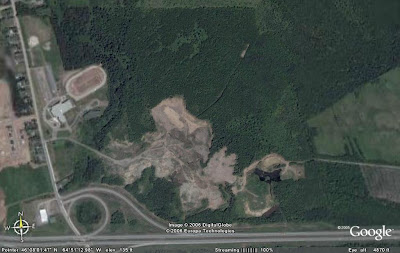
In our own little corner of the world we have a property here at ABU where the campus sits on a much larger parcel of land that was clear-cut in the early 1970's. That is our best bet for the photo below. Notice that the highway has not been twinned and the old farm property that was here before ABU is still intact. In terms of the clear cut it makes for an interesting comment that the parts that were not clear cut are the high ground between Gorge Road and the Gorge Brook, the Gorge Brook area itself and a boggy area in the North - East sector of the property.


What I like about this early view of the property is that it clearly shows the property borders since I am sure the woodcutters would have cut right to the border with the neighbours. It also clearly shows where the logging roads are and that might be useful for access to the woods today.

If we now look at the 2005 Google Earth view of the ABU property we can see that the scrub forest has covered the property again. Up close it is a nasty tangle of poplar, birch and swamp maple with a seasoning of conifers. But it is treed and starting the natural process of succession from cleared land to conifer forest. What is also clear is the gaping hole in the property that is the surface pit for fill that worked the property from the time of the last clear cut and left about a quarter of the property stripped down below the subsoil leaving an almost Mordor like blasted moonscape of scum, slime and tufts of mis-begotten grass.


Well, it looks like we are going to be here for a while and it is clear that the good Lord gave us trees to save us from ourselves so I think we had better start planting some trees.

Tuesday, August 12, 2008

"Recycled" Water ... It's About Time


I love this article in today's New York Times.


I have been lecturing for years that it is the mark of the civilized Western society that we can urinate, defecate and dump chemical waste into our own drinking water and not suffer for it. We can directly connect the success of urbanization with municiple water treatment systems. I always say that more people are alive today because of municiple water treatment than modern medicine ... but no one listens.
The author (not journalist in this case) visits a new water treatment plant and realizes that the purpose of the plant is to treat sewerage and return it to the city drinking water reservoir. The first response is "Yuck" but there is some really well developed science and chemistry here.
What really gets me cranking are the self righteous rural folk that claim that they have their own well and will not "pollute" their bodies with treated water. In most rural settings your well is down stream from someones septic field ... or a cemetery. At least with municple water someone is responsible for monitoring the water quality.
There is one line in the article that I really like and it shows the two objective and subjective sides of the science involved:
"You could argue that in coming to terms with wastewater as a resource, we’ll take better care of our water. At long last, the “everything is connected” message, the bedrock of the environmental movement, will hit home. In this view, once a community is forced to process and drink its toilet water, those who must drink it will rise up and change their ways. Floor moppers will switch to biodegradable cleaning products. Industry will use nontoxic material. Factory farms will cut their use of antibiotics. Maybe we’ll even stop building homes in the desert."
I think I am going to get a copy of the authors book.

Friday, August 08, 2008

Physical Science in the Olympics: Air Quality

There is a fight going on right now between the BBC


And the Beijing Olympic Organizing Committee


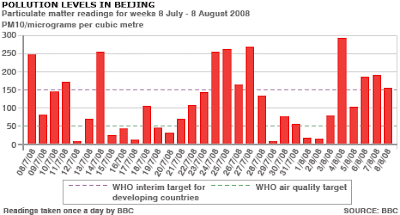
In essence the BBC is saying that the air quality is bad and anyone can see that it is bad. In fact they have been measuring it and the numbers confirm that it is bad. For example, today (08.08.08) they obtained a reading of 191 micrograms per cubic meter of the worst kind of solid particle pollution called PM10 pollution. The WHO cites 50 micrograms per cubic meter as the the criteria for acceptable air but raised that to 150 for Beijing.


On the other side, the organizers of the Beijing Olympics are saying:

" Du said in the past seven days the Air Pollutant Index (API), an indicator of the air quality, in Beijing has been all below Level II, indicating excellent or good air quality.
"Maybe the fog makes it not a nice picture to look at the Bird's Nest or the Water Cube, but the monitor south of the two stadiums reads the API at 80 today. It conveyed a strong message that our efforts had paid off since August," he said. An API rating of 51-100 (level II) means good quality. "


What it comes down to is the number and how it was determined. It is amazing that scientists are capable of using modern technology to measure the same physical phenomenon and get such dramatically different numbers. Physical science is supposed to be above this sort of thing. If the data are distorted then who is distorting them? Is it more likely that the BBC is knowingly publishing false or skewed numbers to support a story and embarrass the host city and country or that the Olympic organizers have "adjusted" their numbers to look better. At least the BBC admits to a 20% error in their measurements. There is another possibility that both sets of numbers are false. We cannot know but there is a third voice on the issue from within China and on that blog this is a picture of the air quality today.


LINK TO BLOG


What we can know is how well the athletes respond to the air. According to the SOURCE OF ALL KNOWLEDGE (Wikipedia) an average human has a deep breath volume of about 5 liters. An adult will make about 40 deep respiration's per minute during physical exertion. So that is about 200 L of Beijing air a minute or one cubic meter of air every five minutes. You have to believe that even elite athletes pulling that kind of air into their lungs for that period of time will have to see an effect. This is the reverse of what high altitude training does to prepare and athlete. At high altitude the air pressure is lower so there is less oxygen, in response the body increases lung capacity and the number of red blood cells to capture as much oxygen as possible. When the athlete returns to sea level there is a short term benefit that can improve performance. In this case however what we are looking at are athletes that can perform well in bad air. I do believe that China may well have an advantage here.

As a post script to this issue there is also a bit of discussion about the air quality of these Olympics compared to air quality in previous Olympic cities such as Athens and Mexico City. According to the BBC this is what athletes faced in previous Olympics.

Other Olympic cities on the opening day of the Olympics:

London (United Kingdom) 21
Athens (Greece) 43
Sydney (Australia) 20
Seoul (Korea) 41

Beijing (China) 191

Source: World Bank 2004 and BBC 2008

Thursday, August 07, 2008

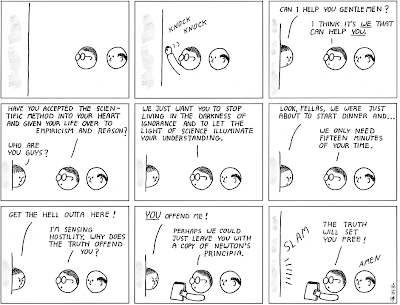
Liberal Arts Science: Opposing the Darkness

Teaching Science in a liberal arts university one often loses a bit of perspective. The reality is that we as a society have to come to some sort of agreement as to what basic level of science knowledge is necessary for functional adults. This is especially true for educated adults since we live in a world largely defined by its relationship with the products of science and technology. That is why we have science requirements for arts students ... the question haw effective a single isolated science credit is in a fourty credit degree. I don't know but I would hope our students would avoid the problem demonstrated in this video. One might even hope that their religious studies courses would explain mystery.


What is endearing about the video below is the completely unashamed attitude that personal assertion is equal to truth.

Christians Behaving Badly

Pound for pound I would say that the weirdest person in the Old Testament is Elisha. Weird stuff just happened around him.


"Elisha Is Jeered 23 From there Elisha went up to Bethel. As he was walking along the road, some youths came out of the town and jeered at him. "Go on up, you baldhead!" they said. "Go on up, you baldhead!" 24 He turned around, looked at them and called down a curse on them in the name of the LORD. Then two bears came out of the woods and mauled forty-two of the youths. 25 And he went on to Mount Carmel and from there returned to Samaria."

What I find striking about this passage is the commonplace almost mundane reporting style. If we were blogging about a trip between Fredericton and Moncton we might mention the high price of corn at roadside vegetable stands in the same tone that our faithful biblical reporter indicates that 42 men get mauled by two bears (OK, I know the plausibility sensors are ringing on this incident but you must remember that people back then were addicted to cheap Kung Fu movies where the bad guys would willingly line up to get their faces smacked).

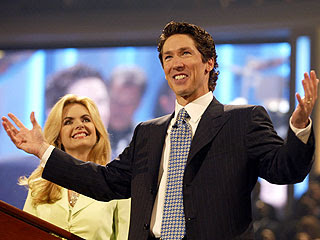
It would, as well, appear that Christians that travel are not always on their best behaviour. I, of course, like you all have been tailgated and passed dangerously by a maniacal person with "Honk if you love Jesus" bumperstickers (which is actually a quite clever way of making you NOT honk at a bad driver). It would appear that more recently the standards of Travelling Christians Behaving Badly has been raised by Victoria Osteen who apparently struck a flight attendant that got in her way down with hemorrhoids. It looks to me like a strange cross between Career Barbie and Harry Potter. What is that worship song we sing ... "Just Like in the Days of Elisha"?


LINK TO COMPLETE STORY

Wednesday, July 30, 2008

Science Under Your Skin

Carl Zimmer is an author and writer that I enjoy reading. He is strongly anti-Creationist but writes in an even-handed rationalist way that avoids the mean spirited positions of Dawkins and his disciples. In fact he makes me think of Stephen Jay Gould.

For whatever reason, Carl took an interest in people who have science tattoos and has now collected images of these tattoos at the link below. I have to admit that I would never get a tattoo myself due to 1) a defining abhorrence of the idea of exposing more of my skin than absolutely necessary, 2) lack of faith in the hygiene practices in most tattoo parlours that I have seen and 3) no easy gloss that escapes this clear statement: Ye shall not make any cuttings in your flesh for the dead, nor print any marks upon you: I am the LORD. Leviticus 19:28
Nevertheless I am impressed that some people would go to the expense and pain of having these ink drawings pushed under their skin. An amazing number are chemical in nature.


Wednesday, July 23, 2008

Something New I am Playing With

I have found a program called CamStudio which is an open source facility that allows capture of audio along with screen capture. I am still working out how to use it but I am currently playing with the idea of posting a series of "videos" that show me solve a problem in real time and record my comments about logic and value. My first attempt is really choppy but I think I can see some promise as I hopefully get better at it.

There is a series of popular videos called "You Suck at Photoshop" that are really quite funny so for lack of a better name I have called this series "USuk@Chemistry" (LINK). That is also a bit of a shout out to a blog that used to exist about ABU Science called "Chem Sucks". I think that in this case my attempt to be funny might send the wrong message so I will probably give them some name like ChemPosts or ChemChats or DrMelHoldsYourHandWhileYouMeltDownatHomeStudyingForTomorrowsTest, you know something like that. Anyway, for those of you that are missing your Dr. Mel fix, here you go.


National Geographic Publishes Worlds Most Disturbing Photo

A couple of posts ago I was on about how we regard some animals as different from others and the fads of the day dictate if we consider them as appropriate for food or commercial exploitation. In the same vein I think the people at National Geographic wanted to publish a photo that would shock people to make a point. It is a very disturbing image concerning the bush meat industry in Africa. It seems that the appearance of oil money in some parts of Africa has resulted in a demand for bush meat and apes appear high on the menu.

This image shows the body of an ape being prepared for market. It seems that the value of the meat is increased if the hair is removed before sale but the skin is intact so they burn it off with a blowtorch. That is the image below.


This image is disturbing to me on a number of levels and I think that the National Geographic Society is going to get a lot of outrage going over this. I hope their gamble pays off. The trade in bush meat that results in these kinds of images needs to stop. But then again I wonder how much meat we would eat if we could see the killing floors of the industrial slaughterhouses of North America. Perhaps it is time for the National Geographic to point it's lens at our own culture before it ignites outrage over other cultures even if it is justified.

Tuesday, July 22, 2008

Mentos and Diet Coke Blurs Physics and Chemistry


You know, when it comes down to it Chemistry calls itself "The Central Science" because when you draw all of science as a Venn Diagram it overlaps with more sciences it than any other. For all that Chemistry is the most insecure science as well. Very few universities are creating pure chemistry departments now and are in fact rolling them into other disciplines such as biology and physics.

The line between Chemistry and the other sciences gets blurrier all the time. Take for example this recent publication by the American Journal of Physics ...


This is of course the famous reaction that spawned a 1000 YouTube videos and made these guys famous.


The article has even been reviewed by the news magazine for the American Chemical Society [LINK] and it turns out that there are a number of factors that combine to make the Mentos / Diet Coke reaction explosive. It appears that the gum arabic used in the composition of the Mentos make the foam more stable and frothier. A microscopic analysis of the surface of the Mentos reveal that it is covered with gas bubble nucleation sites and that the density of the mint meant that it falls to the bottom of the bottle of pop. All useful insights.

But it is not physics. Indeed what exactly do the authors mean in their title when they say "physical reaction". Now I have a little physics in my background and as I remember my terminology a physical reaction is a response to a force (you know ... Newton's Laws and such). I think they are just trying to avoid the word "Chemical" as if it were a dirty word.

I think chemists need to protect their turf while it is still ours and this is not a physics paper. The problem is how do we protest? I mean, we all know the hierarchy ... if you are not smart enough to do math you do physics, if you are not smart enough to do physics you do chemistry, if you are not smart enough to do chemistry ... well you know how it goes etc. We will need to be careful and bide our time but we can't let them walk over OUR turf and pretend to own our ideas. Wait for the right time and remember the codeword (stoichiometry (it is the only science word that chemistry truely owns)).

Monday, July 14, 2008

Welcome to My World in Metaphor

There is a remarkable passage in Mark Twain's "The Adventures of Huckleberry Finn" that goes:

"Sometimes we'd have that whole river all to ourselves for the longest time. Yonder was the banks and the islands, across the water; and maybe a spark--which was a candle in a cabin window; and sometimes on the water you could see a spark or two--on a raft or a scow, you know; and maybe you could hear a fiddle or a song coming over from one of them crafts. It's lovely to live on a raft. We had the sky up there, all speckled with stars, and we used to lay on our backs and look up at them, and discuss about whether they was made or only just happened. Jim he allowed they was made, but I allowed they happened."

My intellectual world occurs at a level far below our technical ability to "see" what we are doing. Oh yes, we can use some very elaborate methods , such as atomic force spectroscopy, to visualise the positions of atoms but only in crystals of heavy atoms.


Any so, if we want to "see" what we are doing in chemistry and biochemistry we sink to metaphor and simile. Whenever we reduce macroscopic objects and even ideas to the microscopic level we lose important information in the simplifications. I don't know how many times I have tried to use a simplified simile to explain a chemical reaction only to end up fighting with students that cannot get past the simile to the concepts taught.


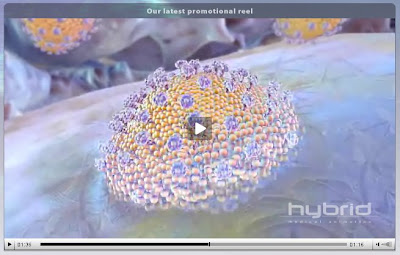
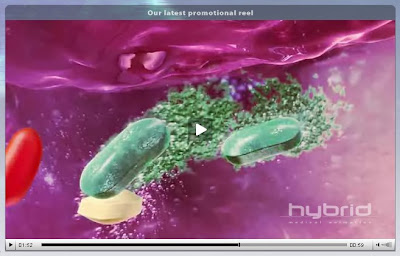
With that all said as a preamble I see a new company has entered the market for industrial animation of science - biochemical - chemical processes. They have a sampler / demo reel at this site:

There are some moments captured in the demo that I like. Such as the moment when an micelle / vesicle carrying a drug molecule contacts a cell wall and submerges like an asteroid into the ocean.


Or this moment that shows a fist full of pills dropping out of the pyloric sphincter an into the acid bath that is your stomach (thankfully a clear colourless liquid in this image, I know I have seen stomach contents in my life and it does not look like this). The pills begin to disintegrate as they travel leaving a drug plume.


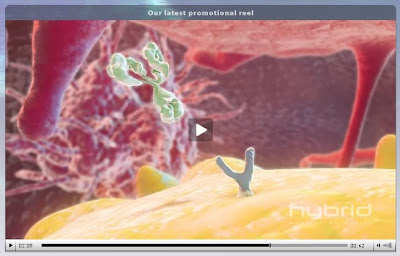
And this image captures the moment in time just before a protein touches a glyco-protein receptor on a cell surface.


It is not my intention to get drawn into the whole irreducible complexity debate. I do however appreciate how these kind of images place an accessible window on the microscopic world of biochemistry that exists in my head. We are all large, salty bags of water with amazing and complex chemistry going on in our cells all the time. These images are nothing like what really happens but until we can see with our own eyes they will have to do.

It does not matter if you believe it was made or just happened. It is astonishing how little we know about the complexity of what happens below our skin. Every step towards humility in our discussions on complexity is a step forward.

Wednesday, July 09, 2008

Made me Laugh

What can I say? Both of these made me laugh but one of them shouldn't have I suppose ... I guess on second thought one of these isn't funny ... can you guess which one?


Tuesday, July 08, 2008

They Shoot Elephants Don't They?

It seems everytime you turn around some poor country in Africa is being over run by herds of elephants and the whole discussion of herd culls occur. Most recently, Kruger National Park is thinking of reducing the size of its herd. Link to Article. The issue is that 100 years ago there were about 6000 elephants left in Africa and a century of conservation means that there are currently about 600,000 and they are straining available resources.

Of course there is a very emotional response, the elephant is iconic for Africa in the same sense that the polar bear is iconic for Canada. There is also a real appreciation that elephants are long lived mammals with strong family ties and apparently real emotions. No one would say they are sentient or conscious but some would argue their intelligence.

The question needs to be asked though, what makes an animal off limits for killing? It would appear that a human emotional response to the animal (kittens and puppies which we kill by the thousands each year) scarcity due to human activity (whooping cranes) and perceived intelligence or kinship (the great apes) all mean that an animal should not be killed.

That brings us to the whales. If I understand the biology, whales are huge, long lived mammals (altho Herman Melville calls them fish and he saw a lot of them) that for the most part we hunted to edge of extinction. And yet, just like the elephants, we left them alone for a century and I tell you, you could walk around the island of Newfoundland on the backs of the whales and not get your feet wet. They are everywhere and are responsible for almost any positive news in tourism for the Atlantic Provinces.

We allowed the elephants to recover and their numbers justify both hunting and culling now. We allowed the buffalo to recover and if you go out west you can get a buffalo burger. We have allowed the whales to recover and some populations could easily accommodate a profitable "fishery" (doesn't it bug you to hear of the fur seal "fishery" each spring but "mammalry" sounds too similar to something else).


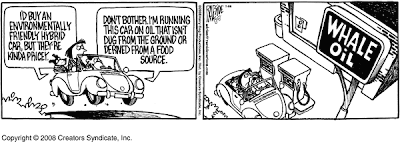
Link to Cartoon

Now, I like the cartoon "The Other Coast" it is gentle humour with a social and environmental consciousness. I am sure that they would be appalled to find that I have linked their cartoon to this discussion. But it was their cartoon today that got my mind thinking on this topic.

But I have to ask, if the biologists tell us that the populations are large enough and stable enough to allow a monitored whale hunt then why not? What is special about the whales as a species that puts them in the same class as the great apes? It would seem to me that Canada has a significant potential natural resource off its shores that it could be exploiting.

This is a photo I took a while ago when we lived in Newfoundland, a friend had taken us out in his boat and this is a whale in the mouth of St. John's harbour. The towers that you see on the horizon are the St. John's Basilica. What is strange about this is that St. John's harbour is essentially a huge sewer and if you go out at the right tide the water coming out of the harbour is brown with "suspended solids". Even so, there you have a whale frolicking in the harbour. Indeed, you can get an often spectacular live view of the harbour from the other side at this link.

And this one is waving good-bye from the waters of Freshwater Bay close to Cape Spear. Like I say, unless we can articulate a reasoned argument for continued protection I fail to see why limited hunts similar to the ones we have for polar bears, elephants and buffalo should not be allowed.


I have no idea where this came from. It is horrifically hot and muggy here and I guess I am feeling a bit like a beached whale and had to release a conservative rant or start biting people.

Friday, July 04, 2008

Summer Internet Surfing

I stumbled across this website that made me laugh ...

The Blog-O-Cuss Meter - Do you cuss a lot in your blog or website?
Created by OnePlusYou
and these are questions that have been bugging me as well ...

How many cannibals could your body feed?
Created by OnePlusYou

Created by OnePlusYou

POSTSCRIPT

So it turned out that this site is not as benign as I first thought. I came across the link in a theology blog that I monitor and just went to the widget site. It figures that the link embedded in the images above in FACT sends you to a Russian "dating" website. I have told these people how old I am, my height and weight and some of my personal preferences in filling out the "questionnaire" to determine how many cannibals I could feed or how much my body is worth. I would assume that the email associated with this website is currently being bombed by "offers" of companionship by busty ladies named Svetlana. I have disabled the links as best I can now and all I can say is that I am glad that I use an Internet pseudonym for this blog. If any of you managed to get caught in this before I posted this warning you have my apologies.

Now, I have all these new email messages from Nadya to read ...

Wednesday, June 25, 2008

Something New Under the Sun

Every now and then you see something that just makes you go hmmm.

There is an abstract for a paper published in the Journal of the American Chemical Society that just pokes you in the eye and says "Not only is this amazing chemistry but traditional publishing just doesn't fully show the awesomeness of the reaction".


At it's simplest level they created a molecule that reversibly breaks a bond when exposed to light. What is cool is the video that goes along with the paper.


Now, photochromic bond dissociation is the cornerstone of the whole discipline of photochemistry (essentially the whole area can be summarized by the statement "Look! We took expensive pure starting materials and shone harsh UV light on them to make complex sewage, we then spent years extracting components from the sewage"). What makes us chemists all giggly about this molecule is the speed of UV capture, bond dissociation and re-association and the fact that the molecule does NOT degrade to sewage. That and the fact that there is the uber cool video showing the whole process.
Why do you care? You know that irritating commercial with the smug near future family that walks outside and their sunglasses immediately turn dark? Now connect the dots and see the bunny. The future is now.

Friday, June 20, 2008

Let the Bitter Howling Begin

If there are any students out there that monitor this blog ... this message is for you. I have decided to allow cheat sheets for my tests and exams in first year chemistry. I know, I know, I fought you guys long and hard on this issue. Our debate always went:

Arguments for Pro -Cheat Sheets:

1) chemistry should be about understanding not memorization
2) memory aids would lower the stress of testing so that the student can do his/her best work
3) creation of the summary sheet is itself an excellent learning process

Arguments for Anti-Cheat Sheets:

1) this course is not a democracy so if I say you need to memorize some basic formulae and logical problem solving sequences suck it up and march like a soldier ... you know what? When I was a student we had to memorize the entire periodic table AND the isotopic masses IN LATIN. I don't care what the professors in OTHER universities are doing, if all the other chemistry professors jumped off a cliff would you expect me to as well? Hmm? Why are you smiling? Did that image make you happy in some way? Well, just for that smarty pants the formal report is due tomorrow ... hand it in just before the unscheduled mid-term.

And at some point in the debate the two sides would descend to childish name calling and secret scheming for retaliation.

So, I have decided to roll over like an old dog. The kicker was a low key investigation at the recent conferences that I attended where the dominant logic was that cheat sheets give the illusion of help but if the student doesn't know the chemistry they will fail anyway.

By the way, I came across this link to a spectacular online periodic table:
I like this quote for the way it makes the causal link between philiosophy and morality:

"To say that a man is made up of certain chemical elements is a satisfactory description only for those who intend to use him as a fertilizer."
Hermann Joseph Muller


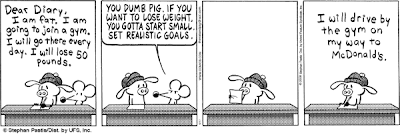
And as I have discovered while on sabbatical ... Jesus may take the wheel but He doesn't do paperwork. My office is a disaster and the lab looks like a combination yard sale - toxic waste dump. I am trying to get things back to "Normal" and I like the attitude in this cartoon:


Sunday, June 08, 2008

A Sunday Quote

I came across this quote today in an article that I was reading and I thought a paraphrase to change "poet" to "scientist" would actually be more an accurate reflection of the goal of science in the liberal arts tradition.

"To a poet, nothing can be useless. Whatever is beautiful, and whatever is dreadful, must be familiar to his imagination: he must be conversant with all that is awfully vast and elegantly little."

Samuel Johnson

Saturday, June 07, 2008

A Very Odd Chiral Separation

There are symmetry laws written into the basic code of the Universe that we live it. If indeed Nature abhors a vacuum it is positively fanatical about breaking symmetry. The more one reads about them the more one is amazed by how basic symmetry rules control so much of what we know about anything.

Simply put breaking symmetry in any fundamental kind of way is strictly forbidden. When symmetry is broken the consequences are pretty amazing. Indeed, if you read Singh's "Big Bang" it is argued that the Universe itself is the result of a symmetry breaking event.

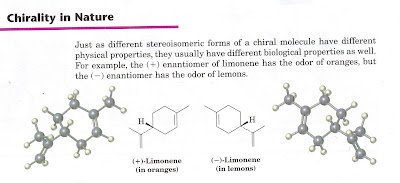
That said, in my discipline of chemistry the most important symmetry rules are written into the nature of tetrahedral molecular substructures in a phenomenon we call chirality. In terms of geometry, if you have a molecule with any point in it where there are four unique molecular bonds to the same atom there are two distinct spatial arrangements that are possible. For simplicity we call them left handed and right handed. It just so happens that the proteins in our bodies are, in fact, long chains of substructures that all have these tetrahedral atoms (pretty much each one an amino acid). What is remarkable (and amazingly improbable) is that each one of these atoms is the left handed version.


McMurry, 5th Ed.


Why is this amazing or improbable? The universal symmetry laws say that when molecules or atoms that are not left handed or right handed form a tetrahedral atom that there must be a 50:50 mix of left and right handed products. That is why scientists and chemists in particular are obsessed with Escher prints. Escher was an artist that made his money creating images where left and right handed images generated each other ...

In fact the only way we can separate handed molecules is with another handed molecule. The question of course is where the broken symmetry comes from but that is an issue for another day. Suffice it to say that chemists have a unique interest in any sort of process that is capable of sorting left and right handed objects.

Well a new one has surfaced.

It was in the Globe and Mail today that another right sneaker has washed up on a beach in British Columbia. What makes that odd is that the foot was still in it. What makes it odder still is that this is the fourth right foot sneaker with a foot still in it to wash up in recent days.


In the absence of a real twisted murderer loose on the West Coast it would appear that this is the result of a natural process of some kind where accidents or suicides result in bodies washing down river and out into the ocean where natural dismemberment results in the feet separating from the bodies but that the right handed foot / sneaker combination follow a different path than the left handed sneakers. The importance of the sneaker is to provide protection for the foot so it stays intact and the natural buoyancy of the sneaker makes the dismembered foot float.

All in all it would appear that a right handed object floating in the ocean is somehow polarized and separated from an equivalent left handed object. The proof of this theory would be to go back to the river source of the bodies and examine the coast in the opposite direction from where the right handed sneakers were found. If this theory is right there should be a stretch of BC coastline where the left footed sneakers accumulate. You heard it here first.

I'm just sayin'.

Wednesday, June 04, 2008

I Have a Bad Case of Piles

I have always been a "clean desk" kinda guy. I have always believed in organization as a second religion and it is foundational to my day to day work as a professor. On the other hand I really did a "Jesus take the wheel" thing with the ABU Science Department this past year and I let a lot of things slide. That has resulted in several piles of paper on my desk next to the piles of textbooks I need to review for the fall semester courses. I hate piles of paper so i have been methodically plowing my way through them dividing them by priority and interest. At the bottom of one pile I found my 2006 - 2007 student evaluations.

Student evaluations have always been difficult for me. At no other time of my year am I brought so close to the question of why I am here at ABU. At Dalhousie, Saint Mary's and Memorial I had spectacular student evaluations that were always better than the departmental averages. But here at ABU it is very different. In fact, my evaluation numbers are all much worse than the ABU averages even on the question of organization and enthusiasm where I figure I should shine. I know all the rationalizations and explanations about why my evaluation numbers might be poor. But it still brings me back to what am I doing here if the students do not understand or appreciate the effort.

So I read my evaluations and they are pretty much the same as ever. There are some students that clearly "get" what I was trying to do and some other students that clearly hate me on an irrational level (disturbingly they are Science majours). The hate filled group are pretty easy to cope with because it is doubtful that I would be able to reach them anyway. But it is the continuing poor marks and negative comments by the middle group of student that cause me to pause. I guess I need to be more intentional in trying to reach that group of students. The problem is that I feel the issue may not be me so much as the content of the courses that I teach. I have a very clear understanding of the necessary content of my courses and I can't change that without making ABU chemistry courses non-transferable. I don't know, sometimes I just don't know.

And so, I deeply appreciate on a different level the kindness of several students for a card they gave me last fall. At moments like these it really helps. Thanks again.

Wednesday, May 28, 2008

Honeydew from the Land of Oilrigs and Cowboys

I have been in Alberta attending chemistry conferences this last week. I made three presentations to good attendances and kind comments. Did some networking (I actually had people sliding their business cards into my hand in passing and giving me the "call-me" gesture) and re-newed some old friendships.


But most of all I attended seminars and lectures.


All about chemistry.


All of them using Powerpoint.


From 8 AM to 8 PM.


For five days.


Man, my brains are dribbling out my earholes.


I must admit to not really adjusting to the Alberta lifestyle so well. It seems to largely feature driving fast and recklessly in large pick-up trucks. Yes, gas is $ 1.30 a liter out here but I guess that is just part of the package. I just left Taco Bell reflecting to myself that I had just come to Alberta to purchase "Mexican" food prepared entirely by Chinese immigrants (they had one designated English speaking woman who shouted orders at the crew in Mandarin). Welcome to the wild west.


I spent the better part of one day listening to the Green Chemistry / Petroleum Chemistry people. I pass for clever in some parts and God-like omniscient in some others but I had a hard time cutting through the language of some of those folk. In one talk it came out that the Petroleum industry has just committed one billion $ for sequestration of CO2. Even in Alberta that is the kind of money that makes people slow down to look. Sequestering CO2 is collecting it and hiding it in mineral formations either chemically as carbonates or under pressure. What is amazing is that after listening to some of the best scientists in the area I could only conclude:

1) at this time we do not have a process that works for any more than 0.1% of (*current*) CO2 emissions

2) that China is currently bringing a new dirty coal fired electrical plant online everyday (yes kids, e-v-e-r-y-d-a-y)

3) if we were to discover a process today that worked, the industrialisation, ethics and environmental approval process in North America would mean that viable use could not occur for 10 years. We do not have such a process.


In terms of CO2 we are totally screwed. The genie is out of the bottle. We have lived a blessed and extravagant lifestyle in front of a watching world for several generations now and they feel entitled to the same thing. Very soon every family in China, India and Indonesia will want a computer, a car and a refrigerator.


After listening, talking and thinking I was only able to conclude one thing. The ONLY short and long term solutions that we have to atmospheric CO2 are to stop emissions and to plant trees. We seem to be socially incapable of the former but I have hopes for the latter. It was therefore amazing to read an article in the New York Review of Books by Freeman Dyson (LINK) that essentially says that we do not have the time or ability to create new industrial processes to solve the CO2 problem once we emit CO2. Dyson said that we DO have the ability to genetically manipulate trees to make them "carbon eating". In my opinion that is brilliant. The only working process that we know of that gets rid of atmospheric CO2 is the natural plant carbon cycle. We just need to tweak the genetic thingees in the trees and they will save us. Tolkien was right, our salvation rests with the ents. We will all soon be tree - huggers.


I'm comin' home.

Saturday, May 17, 2008

Chemistry In the News: The Perils of Modern Life

Canada has a list of industrial chemicals that it considers "toxic" [Link to gov't site]. It has been announced that the list has been just increased by 11 more. It is somewhat alarming that some of the chemicals listed as cosmetics additives or additives to plastics that are in your house right now. Actually the whole cosmetics industry has not covered itself with glory from the get-go. I mean the reality of the cosmetics industry is two-fold: 1) to give a false impression and 2) to achieve goal #1 at any and all cost. There are people out there who would gladly trade a shorter life for "looking good". The illusion of a healthy glow has been achieved for centuries by coating the face with compounds of mercury or antimony and 11 doctors out of 10 will tell you that is a bad bad idea. Indeed, the plastics industry has always tweaked the properties of the pure plastics with additives to suit the end use and the attitude has always been that the additives have not been mobile once Incorporated in the plastic. That would appear to have been an assumption of disputable validity.

The whole moving to a shack in the woods and living off the land is looking better all the time.


The Additions to the Toxic List
(Links to mostly Wikipedia (click on name))*

1] Acetic acid ethenyl ester [Vinyl acetate] Linked to cancer. Used in products such as abrasives, fragrances, perfumes and deodorizers.
Now this is just unfair, it is a nice volatile compound with a pleasing odour and has served us well for centuries and now we turn our backs on it for causing cancer.

2] 1,3-Butadiene, 2-methyl [Isoprene] Linked to cancer. Used in rubber and plastic manufacturing. But, but, but ... it's a NATURAL compound! Nature wouldn't hurt us would it? I mean just who is in charge here maybe we should just show Nature who's the boss. Yeah, that's what we will do. We will kick old Nature right where it hurts, we will pollute the ground, water and air and spit in Nature's eye and tell it to do its best. I mean really what can it do if we drag chemicals out of all natural chemical contexts and use the chemicals in ways that Nature never intended?

3] Thiourea Linked to cancer. Used in electronic products, mining, textiles, dry cleaning and hair preparations and cosmetics. I like this compound I like it alot. I can think of chemical reactions I would like to do with this chemical if I had a nice dark lab and a warm retort (look it up kids it only sounds dirty).

4] Oxirane Linked to cancer and persistent in the environment. Used in epoxy resins for paints, coatings, adhesives and other products, and to produce synthetic glycerin. This has just gotta be the coolest compound on the toxic list. No organic modelling kit will allow you to build this simple molecule because three membered rings are supposed to be rare and unstable and yet I can bet that you have driven down the road and have been passed by a tanker transport of this stuff. Cool but it will tear into organic compounds like a rabbit into wet sand.

5] C.I. Pigment Yellow 34 [chromate yellow] Contains chromium and lead. Linked to cancer. Used as colorant in plastics, inks, paints, coatings, adhesives, textiles and sealants, artists' supplies, cars, vinyl packaging, toys.
I got nothing on this one I would have thought eliminating lead and chromium would have been taken care of years ago. I guess traditional use trumps risk. If you tried to bring something like this on the market now as a new compound you would never get it onto the North American market except in Thomas the Tank Engine toys.

6] C.I. Pigment Red 104 [molybdate orange and molybdate red]
Contains chromium and lead. Linked to cancer, a developmental and reproductive toxin. Colorant for red to orange. Used in paints, coatings, dyes, inks, plastics.

7] Benzenesulfonic acid [Acid Blue] Deemed an environmental hazard. Used in cleaners and disinfectants.
8] Cyclotetrasiloxane, octamethyl [D4]
Deemed an environmental hazard. Used in construction, textiles, leather and hide tanning, paper products, plastic packaging, household appliances, computers, motor vehicle parts and cleaning compounds.

9] Cyclohexasiloxane, dodecamethyl [D6] Deemed an environmental hazard. Used in cosmetics, beauty supplies, perfumes, personal care products, pharmaceuticals and drug products, paper bags and paper products, rubber products, medical equipment and supplies, cleaning compounds, polishes, foods, paints, coatings and adhesives. Building blocks of silicone, application includes breast implants.

10] Cyclopentasiloxane, decamethyl [D5] Deemed an environmental hazard. Used in health and personal care products, footwear, automotive parts, construction, mining and oil/gas extraction, transportation, warehousing and storage, pharmaceuticals, toiletries and cosmetics. Building blocks of silicone, application includes breast implants. This is one fancy family of environmentally hazardous chemicals. The cyclic siloxanes have an amazing and surprising chemistry and the fact that they went from lab to industry so fast is a measure of the niche that they occupy. Makes me wonder what they have to replace these guys. I got to say that this really makes me reconsider the pectoral and butt implants I was thinking about.

11]Phenol, 2,4,6-tris [1,1-dimethylethyl][2,4,6-tritert-butylphenol]
Deemed an environmental hazard. Used as a fuel additive.
OK, now just wait a minute, this is super mesityl phenol. I mean how can you list a chemical with "super" in its name? Who is going to protect us now when we really need an organic oxidant?

* I am well aware that I have gone on record that Wikipedia is a bad source but it is late and I have been assimilated.

Sunday, May 04, 2008

Comic Strip Wisdom


All I can say is ... Amen


And then there is this spin on guy behavior

LINK TO CARTOON

Thursday, April 24, 2008

The Marvels of SulPHur

It would appear that some students in England got tired of the pedagogical / pedantic / infantile nature of the videos that came with their chemistry text and decided to do their own. You have to stay with this one for a bit as it takes a while for them to hit their stride but I must admit I learned a lot from this video.

http://www.youtube.com/watch?v=pmw7JfsNzoY&eurl=http://selenized.wordpress.com/

Wednesday, April 23, 2008

"Natural" Chemistry

I see that an "all natural" desert restaurant chain named Pinkberry in the States has fallen afoul of reality. "Natural" ingredients will rot, decompose or go rancid in an hour to a day or so. For that reason we created the whole industry of food additives so that we can make a donut in 1990 and have it still be "fresh" in 2008.

The harsh reality is that the food industry is designed to sell us water, salt, sugar, fat and air for as high a mark-up as possible. In order to make us to pay for these cheap foods the industry flavours them with "natural" or "synthetic" additives.

So what we mostly pay for is flavoured water, salt, sugar, fat and air that can't go bad. The "best before" date on these foods are mostly made up to make people throw the food away and buy some more not because the food has changed in any significant way. Anyway, welcome to reality Pinkberry. What I like about this article is that they took the time to completely chemically deconstruct the ingredient list for the desert. If fact you could pretty much find the same list for everything from Twinkys to Pogos.


PS I think this is the first post possibly ever where I didn't use ellipses ... but then again I may have overused quotation marks as an indication of dubious meaning.

Monday, April 21, 2008

New Scientist Asks a Great Question

The editors of New Scientist asked 17 of the leading scientists in the world what books shaped their worldview or changed the course of their lives and the results are below. It is interesting how many selections are "adult / academic" selections where I would suspect that the truth is that their paths were shaped much earlier in their lives by textbooks or magazines. I also notice that philosophy or religion really do not make any impact in the list either. I guess I now have a reading list for the summer since I have only read five of the texts listed.

1. Farthest North - Steve Jones, geneticist
2. The Art of the Soluble - V. S. Ramachandran, neuroscientist
3. Animal Liberation - Jane Goodall, primatologist
4. The Foundation trilogy - Michio Kaku, theoretical physicist
5. Alice in Wonderland - Alison Gopnik, developmental psychologist
6. One, Two, Three... Infinity - Sean Carroll, theoretical physicist
7. The Idea of a Social Science - Harry Collins, sociologist of science
8. Handbook of Mathematical Functions - Peter Atkins, chemist
9. The Mind of a Mnemonist - Oliver Sacks, neurologist
10. A Mathematician’s Apology - Marcus du Sautoy, mathematician
11. The Leopard - Susan Greenfield, neurophysiologist
12. Darwin and the Emergence of Evolutionary Theories of Mind and Behavior - Frans de Waal, psychologist and ethologist
13. Catch-22 / The First Three Minutes - Lawrence Krauss, physicist
14. William James, Writings 1878-1910 - Daniel Everett, linguist
15. Do Androids Dream of Electric Sheep - Chris Frith, neuroscientist
16. The Naked Ape - Elaine Morgan, author of The Aquatic Ape Hypothesis
17. King Solomon's Ring - Marion Stamp Dawkins, Zoologist

Now an interesting question would be what selection(s) shaped my life and my worldview. There is no doubt that the one book that I have read and thought about the most would be the Bible and most specifically the writings of Paul. After that would come the Tolkien Grand Tour from "The Hobbit" to the "Book of Unfinished Tales" (which I read about every two years) but that was more for entertainment rather than thinking or changing my life.
When I was a teenager the non-biblical books would have to be both the science fiction and non-fiction selections from Isaac Asimov. What I learned from that experience was that science was one of the few areas where one could stand on solid ground and imagine at the same time.
As I got older I can still remember the electric joy I felt reading Boorstin's "The Discoverers". More recently, "The Scandal of the Evangelical Mind" is a book that has become dated but still engages my mind.
What am I reading now? I am currently reading another one of the genre of science history books that are popular now. It is Bill Bryson's "A Short History of Nearly Everything" and it is a great read but it falls into the trap of giving the illusion of narrative history while in fact mostlydescribing the personal eccentricities of notable scientists. In my opinion Singh's "Big Bang" is much better at combining science, history and personality.
In chemistry there is only one book that stands out in my mind and that is "The Chemistry of the Elements" by Greenwoood and Earnshaw. It is well written and comprehensive if dated. It was shamelessly plagiarized in Housecroft's "Inorganic Chemistry" which at least updated the information.

Thursday, April 17, 2008

Chemistry Builds Character, Courage and Creativity ... Who Knew?

So I am flipping through the Daily Gleaner the last time I was up to Fredericton and my eyes fell upon this add ...

It is about time that when they want to show students facing a true challenge that they don't airbrush some stock photo of some kid climbing Everest. No, in this case the Haley Joel Osment look-a-like is facing the true test of character, courage and creativity ... the titration of acids and bases in graduated cylinders. It wouldn't be character building to do it like everyone else in Erlenmeyer flasks, it wouldn't show courage if he didn't part his hair down the middle like they did in the 70's and as for creativity ... the dude is recording data even though there isn't any liquid in the buret. Perhaps he sees dead chemists. On top of all that the kid is left handed no wonder he had to go to a "special school" ... left handed people are sinister.*

* a joke you won't get until you take organic chemistry and even then some levo people won't think it funny.

Monday, April 14, 2008

Big Pharma Take a Hit

Between all the failed drug trials recently and the problems with side effects in so many prescription drugs this cartoon is a bit like kicking a guy when he is down but it does get to the heart of modern medicine's defining methodology of drugging every problem out of existence. Man that was a long sentence. I mean how many of us have heard of a friend or relative that was on such a complex drug regime that they end up in the hospital because of incompatible prescriptions?

Link to strip

PS How does Forrest Gump know if penguins have nipples or not anyway?

Tuesday, April 08, 2008

The Chemistry Student's Nemesis

We got this catalogue in the mail today and it made me think of stiochiometry.

Moles are actually killed using the unusual poison zinc phosphide. It seems the poison is an effective rodenticide and the rodents find the chemical attractive. The label claims they will die in their tunnels within a day of ingesting the poison.

The reaction to produce zinc phosphide from the elements makes for an interesting balanced chemical equation. I will give an appropriately geeky / nerdy prize to the first ABU student that gives me a correct balanced chemical equation in the comment section of this post and tells me what mass of mole killer they could make from 40 grams of phosphorus.

Saturday, April 05, 2008

Classroom Chemistry Demonstrations

The story is in the news this weekend about a chemistry demonstration in a High School science class here in New Brunswick where a routine demonstration resulted in the injury of a student. Without a doubt this is the worst case scenario short of burning down the school. No teacher would accept any chance that a student could get hurt as a result of a demonstration. But accidents happen. We need to hope that this was a true random accident and pray that the student has a full recovery. It is clear that the teacher is an exceptional, caring teacher and that this incident has deeply affected him, we need to pray for him as well.

It is my position that there is just not enough information out yet to allow us to make anything other than the most general comments. We need to be careful not to overreact or make assumptions.

The link below to the CBC article has some interesting comments in addition to the article from students in support for the teacher. That is very revealing.


This is all part of a cost-benefit calculation that every science teacher has to make. The primary consideration is always "Can I do this safely?" after that comes "Will the students learn anything from the demonstration", "Will the time and effort spent setting up, conducting and cleaning up the demonstration be justified by the facilitation of learning or am I just amusing the students?"

In my case I really agonize over this. I have always used a chalkboard because I felt that writing on the board slowed me down and showed the students that I too had to cope with how to write and draw scientifically. I have always stopped and told stories because I believe that for a lecture to work there must be "intellectual rest periods". I have always done demonstrations both to create breaks in the lecture and to emphasize points that are best learned by observing not being told. In the back of my mind however the rational part of my brain is always yelling "you have 36 hours to teach this material and you are going to blow 30 minutes on a demonstration? ... you do not have time for this".

In my experience demonstrations are an academic highwire where the teacher can look really stupid in front of his students and if something goes wrong people might get hurt. I remember that I used to burn small amount of sulphur in class to show them the cool blue flame. Then one year one of my students turned out to have an extreme allergic reaction to sulphites and she just barely made it to the hallway to escape the slight fumes from the reaction.

I can only see this going one way when it comes to the public schools. All classroom demonstrations will be stopped and the students will be shown videos of the demonstrations. I just do not see the public accepting any risk that when they send their children to school that they might get hurt in a classroom. I hope not, but I really feel that is where we are going.

Risk is one of those things that we have hardwired into our minds. We are usually well aware when we are doing something risky and the response to stress is heightened awareness and more deliberate action. The thing is that we are also conditioned to cope with stress as it becomes a routine part of our lives. In some peoples lives the riskiest thing that they will do during a day is drive down a highway. In spite of that years of coping with the stress of driving now allows them to eat, talk on the phone and drive all at the same time. It is not that they are better drivers ... they are simply conditioned to cope with the stress. Some people would argue that this leads to complacency and accidents. I hope that was not the case this time.

Friday, April 04, 2008

Friday Science Cartoon

I recently came across the comic strip Grand Avenue and there are occasional academic strips that make me laugh.


I found this YouTube video amusing as well in a low tech chaotic way.