The whole moving to a shack in the woods and living off the land is looking better all the time.
The Additions to the Toxic List
(Links to mostly Wikipedia (click on name))*
(Links to mostly Wikipedia (click on name))*
1] Acetic acid ethenyl ester [Vinyl acetate] Linked to cancer. Used in products such as abrasives, fragrances, perfumes and deodorizers.
Now this is just unfair, it is a nice volatile compound with a pleasing odour and has served us well for centuries and now we turn our backs on it for causing cancer.
2] 1,3-Butadiene, 2-methyl [Isoprene] Linked to cancer. Used in rubber and plastic manufacturing. But, but, but ... it's a NATURAL compound! Nature wouldn't hurt us would it? I mean just who is in charge here maybe we should just show Nature who's the boss. Yeah, that's what we will do. We will kick old Nature right where it hurts, we will pollute the ground, water and air and spit in Nature's eye and tell it to do its best. I mean really what can it do if we drag chemicals out of all natural chemical contexts and use the chemicals in ways that Nature never intended?
3] Thiourea Linked to cancer. Used in electronic products, mining, textiles, dry cleaning and hair preparations and cosmetics. I like this compound I like it alot. I can think of chemical reactions I would like to do with this chemical if I had a nice dark lab and a warm retort (look it up kids it only sounds dirty).
Now this is just unfair, it is a nice volatile compound with a pleasing odour and has served us well for centuries and now we turn our backs on it for causing cancer.
2] 1,3-Butadiene, 2-methyl [Isoprene] Linked to cancer. Used in rubber and plastic manufacturing.
But, but, but ... it's a NATURAL compound! Nature wouldn't hurt us would it? I mean just who is in charge here maybe we should just show Nature who's the boss. Yeah, that's what we will do. We will kick old Nature right where it hurts, we will pollute the ground, water and air and spit in Nature's eye and tell it to do its best. I mean really what can it do if we drag chemicals out of all natural chemical contexts and use the chemicals in ways that Nature never intended?3] Thiourea Linked to cancer. Used in electronic products, mining, textiles, dry cleaning and hair preparations and cosmetics.
I like this compound I like it alot. I can think of chemical reactions I would like to do with this chemical if I had a nice dark lab and a warm retort (look it up kids it only sounds dirty).4] Oxirane Linked to cancer and persistent in the environment. Used in epoxy resins for paints, coatings, adhesives and other products, and to produce synthetic glycerin. This has just gotta be the coolest compound on the toxic list. No organic modelling kit will allow you to build this simple molecule because three membered rings are supposed to be rare and unstable and yet I can bet that you have driven down the road and have been passed by a tanker transport of this stuff. Cool but it will tear into organic compounds like a rabbit into wet sand.
5] C.I. Pigment Yellow 34 [chromate yellow] Contains chromium and lead. Linked to cancer. Used as colorant in plastics, inks, paints, coatings, adhesives, textiles and sealants, artists' supplies, cars, vinyl packaging, toys.
This has just gotta be the coolest compound on the toxic list. No organic modelling kit will allow you to build this simple molecule because three membered rings are supposed to be rare and unstable and yet I can bet that you have driven down the road and have been passed by a tanker transport of this stuff. Cool but it will tear into organic compounds like a rabbit into wet sand.5] C.I. Pigment Yellow 34 [chromate yellow] Contains chromium and lead. Linked to cancer. Used as colorant in plastics, inks, paints, coatings, adhesives, textiles and sealants, artists' supplies, cars, vinyl packaging, toys.
I got nothing on this one I would have thought eliminating lead and chromium would have been taken care of years ago. I guess traditional use trumps risk. If you tried to bring something like this on the market now as a new compound you would never get it onto the North American market except in Thomas the Tank Engine toys.
6] C.I. Pigment Red 104 [molybdate orange and molybdate red]
Contains chromium and lead. Linked to cancer, a developmental and reproductive toxin. Colorant for red to orange. Used in paints, coatings, dyes, inks, plastics.
7] Benzenesulfonic acid [Acid Blue] Deemed an environmental hazard. Used in cleaners and disinfectants.
8] Cyclotetrasiloxane, octamethyl [D4]
Deemed an environmental hazard. Used in construction, textiles, leather and hide tanning, paper products, plastic packaging, household appliances, computers, motor vehicle parts and cleaning compounds.
Deemed an environmental hazard. Used in construction, textiles, leather and hide tanning, paper products, plastic packaging, household appliances, computers, motor vehicle parts and cleaning compounds.
9] Cyclohexasiloxane, dodecamethyl [D6] Deemed an environmental hazard. Used in cosmetics, beauty supplies, perfumes, personal care products, pharmaceuticals and drug products, paper bags and paper products, rubber products, medical equipment and supplies, cleaning compounds, polishes, foods, paints, coatings and adhesives. Building blocks of silicone, application includes breast implants.
10] Cyclopentasiloxane, decamethyl [D5] Deemed an environmental hazard. Used in health and personal care products, footwear, automotive parts, construction, mining and oil/gas extraction, transportation, warehousing and storage, pharmaceuticals, toiletries and cosmetics. Building blocks of silicone, application includes breast implants. This is one fancy family of environmentally hazardous chemicals. The cyclic siloxanes have an amazing and surprising chemistry and the fact that they went from lab to industry so fast is a measure of the niche that they occupy. Makes me wonder what they have to replace these guys. I got to say that this really makes me reconsider the pectoral and butt implants I was thinking about.
11]Phenol, 2,4,6-tris [1,1-dimethylethyl][2,4,6-tritert-butylphenol]
Deemed an environmental hazard. Used as a fuel additive.
OK, now just wait a minute, this is super mesityl phenol. I mean how can you list a chemical with "super" in its name? Who is going to protect us now when we really need an organic oxidant? This is one fancy family of environmentally hazardous chemicals. The cyclic siloxanes have an amazing and surprising chemistry and the fact that they went from lab to industry so fast is a measure of the niche that they occupy. Makes me wonder what they have to replace these guys. I got to say that this really makes me reconsider the pectoral and butt implants I was thinking about.11]Phenol, 2,4,6-tris [1,1-dimethylethyl][2,4,6-tritert-butylphenol]
Deemed an environmental hazard. Used as a fuel additive.
* I am well aware that I have gone on record that Wikipedia is a bad source but it is late and I have been assimilated.


 All in all I was very impressed. They are teaching about 1000 students in classes of about 120. We sat in on one regular lecture given by my post-doctoral supervisor. It was clear that the students had bought into the whole concept of the text and most were recording their notes directly into their textbooks.


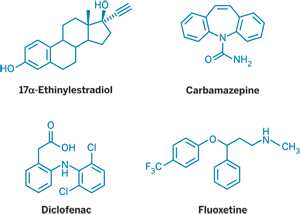

 So, there is a chemistry blog that I monitor and the young man that maintains the site has been blessed with a child. This prompted a debate on the disposable versus cloth issue.


 This was one of the Victorian remedies for constipation and was advertised as a way to "untwist the gut". You know what is most disturbing about this story? They captured the mercury and used it for the next customer. Eewww. They must have been seriously afraid of constipation in those days to slam down "recycled" mercury.


 LINK TO SITE
 But this one made me laugh too:


 With this detail:
 You gotta love a chemistry set that allows you to work with "harmless radioactive" chemicals. Ah, the 1960's you had to live then to understand.